There is no skip button · Part 1
The strange pleasure of AI that feels analog
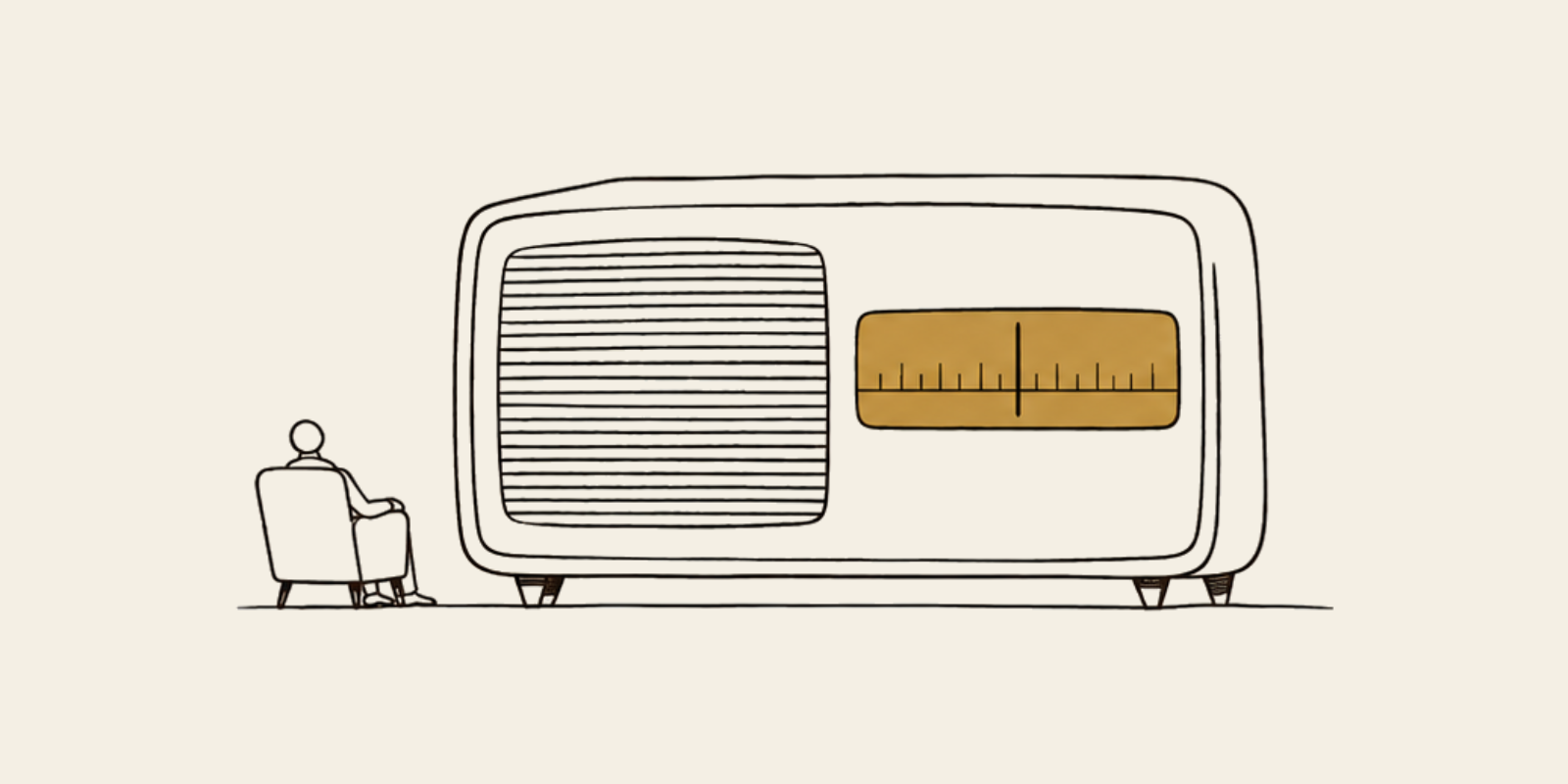
An AI-run radio station on my own record collection ends the tyranny of choice. It is my music, shaped to my day, and it does all the choosing.
I’m a lifelong music collector – thousands of records, 35,000 digital tracks, even a bunch of boxes of CDs in storage somewhere I should probably dig out now that they’re in demand again. But I have a confession: up until recently, I largely ignored it all. I had become Spotify lazy (spotiflazy?).
In my defense, Spotify and the other services earned it. They’ve spent nearly two decades making music frictionless, and they solved a lot. Storage. Portability. The record you can’t find. The one you didn’t know existed. Every song ever recorded, on every device I own, for the price of one CD a month.
What they never solved is the tyranny of choice. They made it worse. My collection gave me 35,000 things I could play next. Spotify gave me a hundred million.
My defense was to shrink. I played the same things over and over. I stopped looking for new music, because looking meant choosing. The biggest record store ever built, and I kept walking to the same shelf.
Their answer to this is the algorithm, and I’ll give it this: it’s pretty good. It knows roughly what I like. It rarely embarrasses itself. But pretty good is not great. It’s good enough that I never quite turn it off, and never good enough that I stop reaching for the skip button.
So today let’s talk about the thing that did solve it: an AI radio station that runs in my house, plays only my music, and does not ask my opinion about anything. I want to explain what it is, why it works on me, and why I think it gets something right that much of the consumer internet gets wrong.
I.
The project is called SUB/WAVE. It’s open source, and its pitch is that it turns a personal music library into an AI-run internet radio station.
That’s accurate, but it undersells the strange part.
SUB/WAVE doesn’t generate music. It doesn’t build you a playlist. It runs an actual broadcast — one continuous stream, with an AI DJ choosing records and talking between them. If five people tune in, all five hear the same thing at the same moment. The station keeps playing when nobody is listening. There is no skip button.
Read that last sentence again, because it is the whole product. For twenty years, digital music has moved in one direction: more personalization, more control, more you. And here comes this piece of software whose central feature is taking the controls away.
It has plenty of very cool AI in it. The DJ has skills it can call on between records. It does stem splitting to blend one track into the next. But none of that is what makes the experience. What makes the experience is everything it won’t let me do.
I found this weirdly thrilling.
II.
I expected the AI DJ to be the fun part. And it was, for about a day. Hearing a synthetic host introduce a record from your own shelf is novel in the way that most AI demos are novel: you say “huh,” and then you move on.
What lasted was simpler. Something was already playing. The next record had already been chosen. I didn’t have to choose.
And unlike the algorithm, the choosing was great. I think I know why. Spotify’s algorithm has to pick from a hundred million songs on behalf of hundreds of millions of people. Pretty good is about the best that job allows.
My station has an easier job. It can only choose from records I already decided to keep. It can surprise me — it does, constantly — but only with my own taste. The same shelf I had been walking to for years turned out to have 35,000 records on it. Albums I had carefully collected, tagged, and then forgotten for a decade started turning up again, usually at exactly the right moment.
That, I think, is the trick. It is much easier to hand over the wheel when the car can only go places you already like.
III.
The second thing that makes it work is that the station knows what time it is.
My days have a shape. Mornings, I want singing. During working hours I want instrumentals, because I can’t think with someone else’s words in my ear. In the evening the voices come back. Overnight, it goes instrumental again.
That is the only thing the clock changes. The music itself stays inside one idea all week, which I eventually wrote down as: heavy, syncopated, pocket-based music that flows smoothly, from anywhere in the world. The best run I’ve heard went from a Zambian record to Augustus Pablo to Mongo Santamaría to Weldon Irvine to a Nigerian one to Roy Ayers. Six picks, five countries, one feel. That is what I want from a DJ, human or otherwise: hold the vibe steady and let the genre travel.
The instrumental hours have space names — Deep Space, Low Orbit. The vocal hours have time names — The Pocket, Loose Time. The station is called Space & Time. (Yes, I named the shows. I contain multitudes, and one of them is a program director.)
I never look at the schedule. I press play, and it is already the right kind of hour.
IV.
A quick word on how this works, for the curious. I’m saving the deep technical version — and the long list of things that went wrong — for another post.
Everything runs at home. A small, open-source language model on a Mac mini does the thinking: it picks the next record and writes what the DJ says. A separate voice engine speaks the lines. The audio gets mixed into a single live stream.
The part I find most charming is that the DJs are just descriptions. Each one is a short paragraph of plain English — who they are, how much they talk, what they care about. I have six. Aurora does mornings. Nova takes the working day. Cosmo runs the evenings, says the artist’s name, and says nothing else, which makes him my favorite. Luna has the nights.
The shows are descriptions, too: a few sentences about how those hours should feel, plus a list of the records that belong there.
Between songs, the DJ has a handful of skills it can reach for. It can read the weather or the headlines, note an album’s anniversary, dig up a fact about whatever is playing, or tease a deep cut. About once an hour, a bumper reminds you what station you’re listening to.
And I get one vote that outranks all of it. When I hear something that doesn’t belong, I tell it, and it won’t play it in that context again. The station gets a little more like me every time.
V.
To be clear, this is not a product. Nobody is going to sell you one. It took real effort to set up, and it is a radio station with, on a good day, one listener.
But I keep coming back to how different it feels from the AI we are usually offered. Most consumer AI is pitched as a way to do more: more output, more options, more content. This is AI as a way to do less. It takes a decision I was bad at and quietly makes it for me, inside limits I set, using only things I already love.
It also fits a moment. People are going back to old formats. Vinyl sales in the US have grown for nineteen straight years, and last year they passed a billion dollars for the first time since 1983. Now CDs are coming back too — see the boxes in my storage unit. Teenagers are buying VHS tapes and ten-megapixel point-and-shoots from 2008. I don’t think that is only nostalgia. Those formats have edges. An album has two sides. A roll has 36 exposures. You can’t skip, scroll, or get more, and that turns out to be the appeal.
My station is a strange hybrid of that impulse. The media is entirely digital. The thing that makes it possible is AI, about the newest technology there is. But the format is old. It’s radio: one signal, a voice between the records, someone else at the controls, and you either trust them or change the station. It feels analog, even though nothing in it is.
I grew up with that. I had forgotten how restful it was.
Now I press play and hear what’s on. It’s my music, it fits the hour, and I didn’t pick any of it.
Space & Time is on the air at subwave.h3r3.com — behind a password, for now.